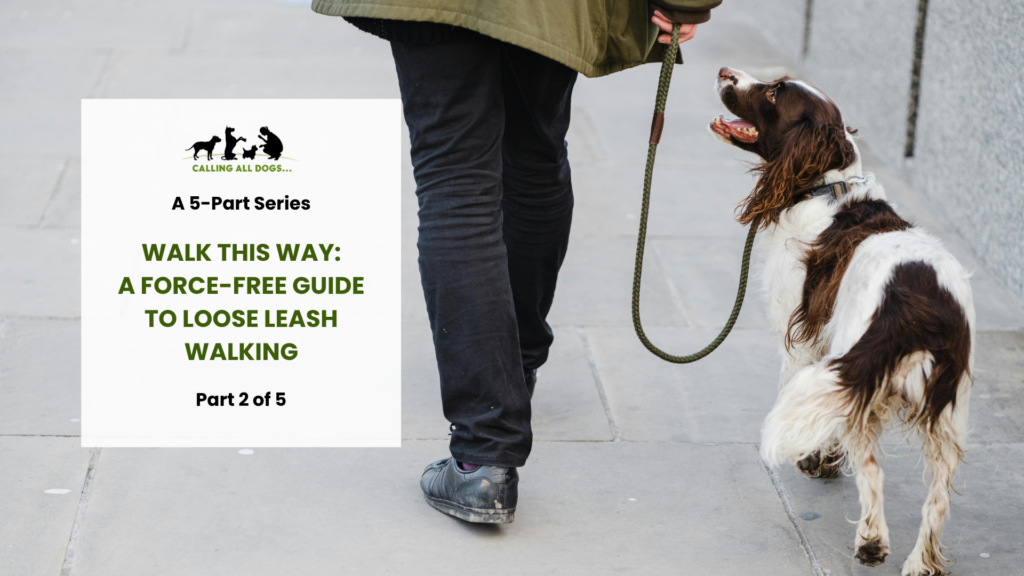
I’ve tried everything, but my dog just keeps pulling!”
I hear this a lot. And I believe you. You’ve watched the YouTube videos. You’ve stopped walking when the leash goes tight. You’ve done the treat-in-front-of-the-nose thing. And your dog still drags you down the street like you’re a sled.
If you’ve been practicing loose leash walking outside and hitting a wall, you’re not alone. In Part 1 of this series, we explored why dogs pull in the first place.
Now we’re going to talk about the 4 basic skills that you and your dog need before ever hitting the sidewalk: a marker cue, automatic check-ins, a strong reinforcement zone, and your walking setup.
None of them are complicated. But without them, no amount of “stopping when the leash goes tight” will stick. Once we build those in, everything else will begin to fall into place.
Why Foundation Skills Matter More Than You Think
Let me tell you about Bella, a two-year-old Lab mix. Her pulling had gotten so bad that her owner’s arm had literally been yanked out of its socket. “We’ve been practicing loose leash walking for months,” she told me. “Nothing works.” After a quick demonstration of how they walk, it was clear what they were missing: the foundational skills that make loose-leash walking possible in the first place.
Here’s the thing most people don’t realize: loose-leash walking isn’t a single skill. It’s a combination of multiple foundational skills. Most owners try to teach the finished product before the building blocks are in place. That’s like trying to teach someone to drive on the highway before they’ve ever sat in a car. Too much, too fast, and the dog doesn’t have what they need to actually succeed.
Foundation Skill #1: Introducing a Marker
Before your dog can learn anything, they need to know when they’ve gotten it right.
That’s what a marker does. It’s a precise signal that tells your dog that the exact thing you just did earned the reward. When a behavior gets reinforced, it becomes more likely to happen again. This works in your favor when you’re intentional about it, and against you when you’re not.
As we talked about in Part 1, pulling continued because it kept working. Every time your dog hit the end of the leash and still got to where they wanted to go, that pulling was reinforced. The marker is how you flip that equation and start putting the right behaviors on a reinforcement history instead. But only if the timing is right.
Here’s why timing matters. By the time you reach into your treat pouch, find a piece of food, and hand it to your dog, a second or two has passed. In that time, your dog may have already looked away, barked, or taken a step. Without a marker, you’re rewarding whatever they happen to be doing when the food arrives, not the thing you actually wanted. A marker freezes the moment. The instant your dog does the thing, you mark it. Now they know exactly what they’re getting paid for, even if the treat takes a second to arrive.
Most people use a clicker or a single word. “Yes” and “yip” are common. What matters is that it’s short, consistent, and only means one thing: treat is coming.
Here’s How to Train It
You have to build value for your marker before getting started. This is called loading. Here’s how to do it:
- Go to a quiet area.
- Say your marker word once, or click if you prefer to start out with a clicker.
- Pause for a split second.
- Move your hand to give your dog a treat.
- Repeat that ten to fifteen times in a row.
You’re not asking your dog to do anything. You’re just building the association: that word means food is coming. After a few sessions, you’ll notice your dog’s ears perk or their head snaps toward you the moment they hear it. That’s when you know it’s loaded.
Foundation Skill #2: Check-Ins
Before your dog can walk nicely on a leash, they need to think you’re worth paying attention to. Not because you told them to look at you. Not because you made a sound or tugged the leash. Because they decided to do so on their own. That’s a check-in.
Here’s How to Train It
- Put your dog in a low-distraction space, like a hallway, and just wait. Don’t say anything. Don’t move toward them. Don’t do anything to get their attention. Let them look around, sniff, do whatever they want.
- The moment they turn and look at you, mark it and reward.
- They might look away after eating the treat, or they might look up at you. Mark and reward when they look at you again.
- Repeat.
That’s it. What you’re building is a dog who has learned that checking in with you pays off. Once it’s solid in the hallway, take it somewhere new. The backyard. The driveway. The parking lot of a pet store. Dogs don’t automatically transfer skills from one place to another the way we do. A dog who checks in beautifully at home can act as if you don’t exist at the park. That’s not stubbornness, it’s just how dogs learn.
Every new environment is a new lesson, so you have to build the habit wherever you go. What you’re building here isn’t obedience. You’re building a communication system. Your dog learns that paying attention to you is valuable and rewarding. That way, you won’t spend all your time fighting for their attention in the future.
I also use check-ins as a diagnostic tool at the start of every walk. Before we go anywhere, I’ll stop and wait. How long does it take my dog to look back at me? Two seconds? Ten? Still hasn’t happened? That tells me exactly where my dog’s head is before we’ve taken a single step. If check-ins are slow or absent, I know the environment is too much right now, and I’ll adjust before we’re already in the middle of it. This is especially helpful for reactive dogs.
Foundation Skill #3: Reinforcement Zone
Before your dog can walk nicely on a leash, they need to understand that being next to you is the best place to be. Not because the leash is holding them there. Because that spot has a history of good things happening. This is called a reinforcement zone, and you build it before the leash ever comes into play.
Here’s How to Train It
- Pick a side, left or right, and commit to it. Switching sides in the early stages leads to zig-zagging, and you’re one distracted moment away from getting tripped. Stay consistent.
- Start walking around inside the house or yard without a leash
- Every time your dog drifts into position next to your leg, mark it and reward at your hip. Not out in front of you, not behind you. Right at your hip. Where you feed is where they learn to be, so if the treat is delivered out in front of your body, you’re teaching your dog to forge ahead.
- Repeat.
With enough repetitions, your dog will start gravitating toward it quicker and staying there longer.
Once that value is built, you can add the leash.
Foundation Skill #4: Your Setup
Where and how you hold the leash matters, and figuring out how to add in the treats, and possibly the clicker, can be confusing for both you and your dog. Below are examples with our dog on the left and right sides.
Say your dog walks on your left. You have two ways to do this. Pick whichever feels natural.
Option 1: Treats on your dog’s side. Hold the treats in your left hand, on the same side as your dog. Your leash and clicker go in your right hand. To reward, drop your left hand straight down to your dog’s mouth, right along the side of your left leg. No reaching, no twisting. The treat lands where he’s standing, next to your knee.
Option 2: Treats in your far hand, reaching across. Hold the treats in your right hand and your leash and clicker in your left. To reward, bring your right hand across the front of your body, past your stomach, all the way over to your dog on your left. Deliver the treat down at his head while he’s beside your left leg. The key is reaching far enough. If your hand stops short in the middle of your body, your dog has to step forward to get the treat, which is the habit you’re trying to avoid.
If your dog walks on your right, flip it. Treats in your right hand for Option 1, or treats in your left hand and reaching across for Option 2. Either way, the treat has to arrive in position, right beside your leg. When you reward out in front of you instead, your dog learns to lag behind or swing wide to get in front of your treat hand.
One thing to watch as your dog reaches for the treat: don’t reward them for stepping in front of you. The treat should land while your dog is beside you, not when they swing forward to meet your hand. Once your dog can walk nicely without treats, hold the leash in whichever hand you like.
Your leash hand should be relaxed. I see so many handlers white-knuckling the leash like they’re holding onto a runaway horse. Holding your dog next to you on a tight leash doesn’t teach him that your side is where he belongs. He’s only there because the leash won’t let him go anywhere else. He isn’t choosing the position, so he isn’t learning it. What he learns instead is that walking means leaning into tension. A tight leash starts to feel normal. So the moment you loosen up, he has no reason to stay close, because being there was never his idea.
Keep the leash loose but not dragging. You want about a J-shape in the leash when your dog is in the right position. That gives them freedom to move slightly without creating tension, but not so much freedom that they’re six feet ahead of you.
For now, practice these options and figure out which works best for you.
What You’ll Notice When You Build These Skills First
None of this happens on the sidewalk yet, and that’s the point. You’re building each piece somewhere quiet, so it holds up later, when there’s a squirrel across the street and a dog barking two houses down. Put in the reps now, and the walk starts to feel different. Your dog checks in without being asked, settles into your side on their own, and the leash stays loose because that spot is where they want to be. That’s your foundation. Once it’s solid, you’re ready to put it in motion.
In Part 3 of this 5-part series, we’ll dive into the mechanics of loose-leash walking. How to move forward with your dog at your side, what to do when your dog starts to pull, and how to get them back in the proper position next to you.
Your Turn
What’s your biggest challenge with getting your dog’s attention when you’re practicing at home? I’d love to hear what you’re working through in the comments below. Sometimes the “simple” foundation skills are the hardest to nail down, and I might be able to offer a specific tip for your situation.
