If you’ve ever been dragged down the sidewalk, shoulders aching, leash wrapped around your wrist while your dog strains toward a squirrel (or another dog, or honestly, a leaf blowing in the wind), you’re not alone. I’ve been there. What should be a simple, enjoyable walk turns into a full-body workout, and not the kind you signed up for.
But here’s the truth: leash pulling isn’t a sign that your dog is bad, dominant, or trying to control you. It’s a training gap. And once you understand what’s actually driving the behavior, you can start to change it.
That’s what this series is all about. “Walk This Way: A Force-Free Guide to Loose Leash Walking” is a deep dive into helping you and your dog actually enjoy your walks together. In this first article, we’re laying the foundation. Before you can change the behavior, you need to understand why it’s happening in the first place. So let’s dig in.
Your Dog’s Nose Is Processing a World You Can’t Even Perceive
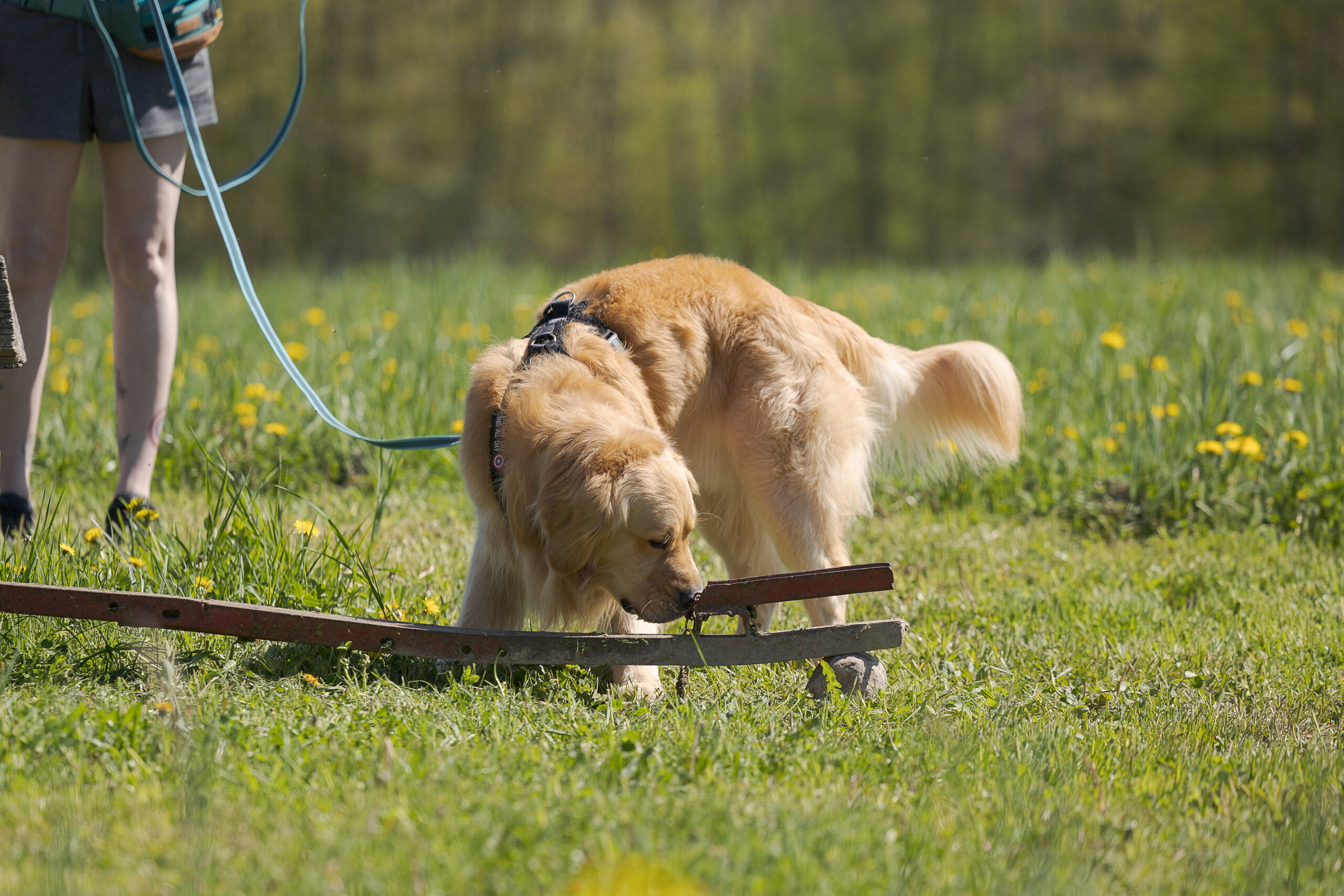
My golden retriever Fisher competing in a NACSW nose work trial — a perfect example of a dog’s powerful scenting ability in action.
While you primarily take in the world through your eyes and ears, a dog’s nose is doing most of the work. What may look like “just sniffing” to us is often a dog gathering detailed information about their environment. With their noses estimated to be 10,000 to 100,000 times more powerful than ours, every inch of ground is a sensory experience we can’t begin to imagine.
To put that in perspective: a dog can detect a single drop of blood diluted across an Olympic-sized swimming pool. On a walk, they can identify which dog passed by a spot hours earlier, whether the dog was healthy or sick, male or female, and how long ago the dog was there. When your dog stops to sniff a patch of grass for 30 seconds, they are not stalling. They are taking in scent mail left by other animals and the environment around them. No wonder they want to rush ahead.
Dogs have been used in police work for decades precisely because of their incredible noses — tracking missing persons, detecting narcotics and explosives, and search-and-rescue operations all depend on a dog’s ability to follow scent. In fact, their noses are so remarkable that an entire sport has been developed around it: the National Association of Canine Scent Work (NACSW) is just one of the organizations that lets everyday pet dogs tap into that same natural ability, searching for target odors in boxes, buildings, and outdoor areas. My golden retriever, Fisher, even travels across the East Coast to compete in scent work trials. It’s one of the fastest-growing dog sports out there, and it’s all about letting dogs do what they were born to do.
Your Dog’s Body Was Built to Move Fast
Dogs are naturally faster than humans. A lot faster. Their preferred walking pace is roughly twice ours, and their bodies are built for efficiency at those speeds. When you ask your dog to match your leisurely stroll, you’re essentially asking them to walk in slow motion.
Unlike us, dogs are quadrupeds — their weight distributed across four limbs, giving them a low center of gravity and a natural forward drive. Their movement is fluid and energy-efficient at a trot or run, powered by some of the largest muscles in their body: the chest, shoulders, and hindquarters. When a dog leans into a leash, they are doing exactly what their body was designed to do. You, on the other hand, are a biped pulling back with your arms and core against an animal whose entire skeletal structure is optimized for forward thrust.
Add in the excitement of outdoor smells, sounds, and sights, and you’ve got a dog whose brain and body are both working against you. At your pace they’re constantly adjusting, balancing, and fighting their natural biomechanics — and the leash becomes the only thing standing between them and everything they want to investigate.
Reinforcement History: Every Pull That Worked Taught Your Dog to Pull Again
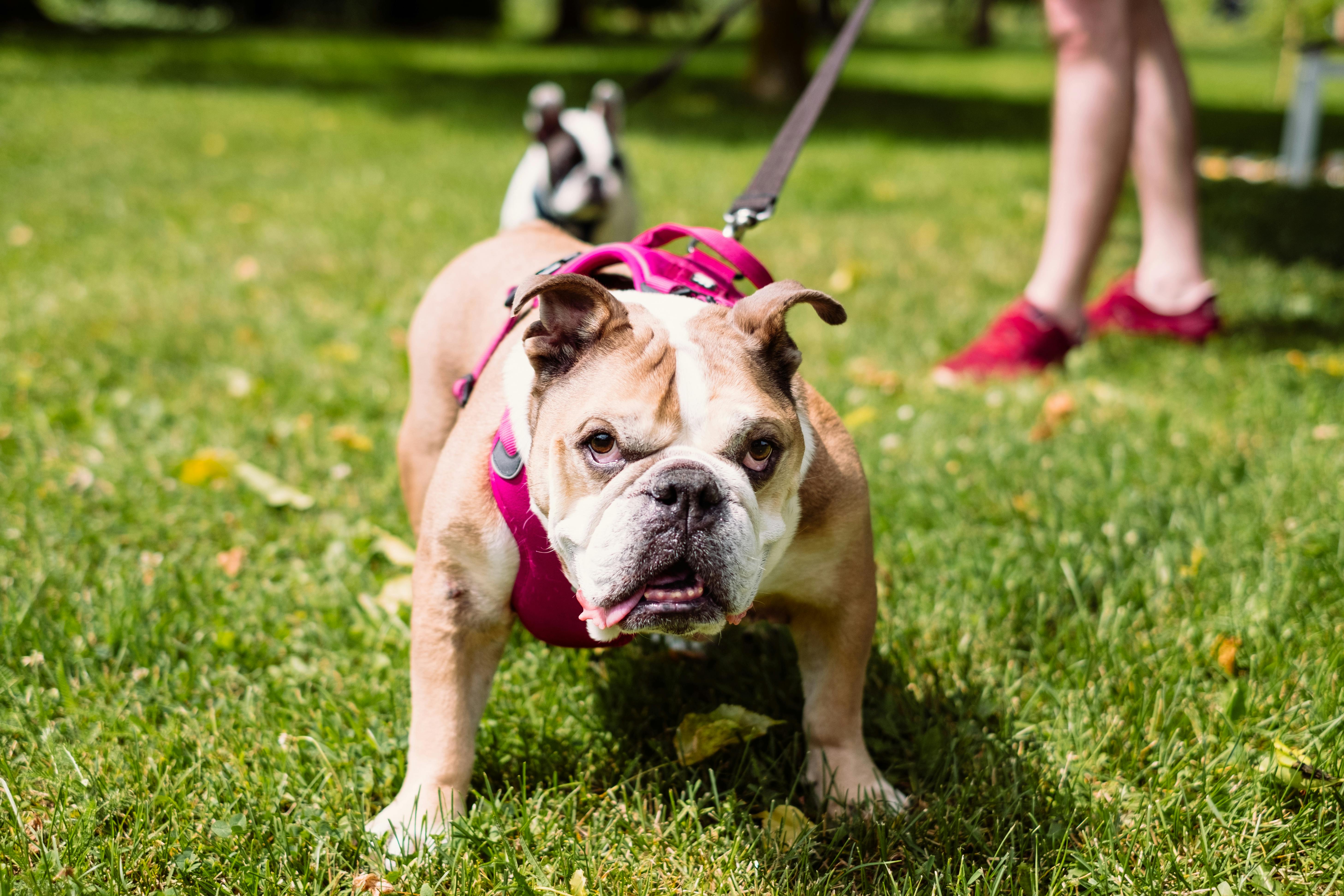
Many owners think that their dog simply needs to get pulling out of their system, or be corrected with a collar pop or other forms of punishment enough times, and they will grow out of it. The opposite is true: dogs don’t grow out of unwanted behaviors; they grow into them. The more a behavior is rehearsed and repeated over time, the more ingrained and automatic it often becomes.
Here’s what’s really going on at a behavioral science level. Pulling is what we call a self-reinforcing behavior. Every single time your dog lunges forward, and you follow, the behavior gets rewarded. They wanted to reach that fire hydrant. They pulled. They got to the fire hydrant. Behavior reinforced. You didn’t mean to reinforce it. But it happened anyway. That’s how learning works, whether we’re paying attention or not.
Think about a toddler in a grocery store who spots the candy aisle. They start asking to go to the aisle and look around. You say no. They ask again. You say no. They pull on your hand, cry, circle back to it, and ask one more time. And sometimes, just to get through the store, you give in. That one moment of giving in is all they needed. Now they know it works. Next time they want something and you say no, they try again and hold out a little longer than before because the last time they kept at it long enough, they got what they wanted.
In this analogy, the toddler is your dog, and the candy is what they want to investigate up close. Pulling gets them to where they want to go. The more it works, the more persistent they become.
When you’ve spent months or years with a pulling dog, you’ve essentially been running a very consistent training program. Just not the one you intended. The good news? You can start a new one.
It’s Not Dominance. Please, Let’s Let That Go.
I still cringe when I hear someone say their dog pulls because they “want to be the alpha.” I know it sounds harsh to say that framework causes real harm, but it does, because it leads people toward responses that don’t work and often make things worse. Unfortunately, dominance-based ideas have been heavily portrayed in television and media for years because dramatic confrontations and seemingly quick results make for entertaining content, even when the methods themselves are outdated or ineffective long-term.
The American Veterinary Society of Animal Behavior (AVSAB) has been clear on this point: dominance theory as a framework for explaining companion dog behavior lacks scientific support. Dogs are not on a constant power grab. They’re not strategizing about how to rank above you in some household hierarchy. Your dog pulls because pulling has been accidentally rewarded. That’s a training problem, not a personality flaw. And training problems have training solutions.
Just because a dog walks in front of you doesn’t mean they’re trying to control you. Just because they ignore you when something exciting is nearby doesn’t mean they’re being disrespectful. It means the environment is more reinforcing than you are in that moment, and that’s something we can absolutely change.
This matters because if you think the problem is dominance, you might reach for a choke chain or a prong collar. And not only do those tools fail to teach your dog what you actually want them to do, but they can also damage trust, increase anxiety, and, in reactive dogs, especially, create serious fallout. That’s not the path we’re taking in this series.
A Force-Free Philosophy Isn’t Just “Being Nice”
I want to address this directly because I hear it sometimes: “Isn’t positive reinforcement just bribing your dog? Isn’t it letting them get away with things?” No. And here’s why that framing misses the point entirely.
Science-based, force-free training works because it communicates clearly. When your dog does something right and something good happens, their brain files that away. “That behavior is worth repeating.” When something confusing or painful happens instead, they don’t always connect it to the behavior you were trying to address. They might connect it to you. Or to the other dog down the street. Or to the leash itself.
Aversive methods can suppress behavior in the short term. But they don’t teach your dog what to do instead. Suppressed behavior doesn’t mean resolved behavior. It means a dog who’s learned not to show you what they’re feeling, and that creates its own serious problems down the road, especially in anxious or reactive dogs.
Positive reinforcement builds a deeper bond because your dog starts to associate you with good things happening. You become relevant. You become worth paying attention to. That’s the whole goal of loose leash walking: your dog chooses to stay near you because being near you is genuinely rewarding. That’s not a bribe. That’s a relationship.
What Comes Next: Building the Foundation for Loose Leash Walking
Understanding why dogs pull is the first step. Now you know it’s not about dominance or stubbornness. It’s about natural movement patterns, biological drives, and reinforcement history. You’re not dealing with a behavior problem. You’re dealing with a training opportunity.
In the remaining articles of this series, we’ll dig into the practical how-to for teaching loose-leash walking. You’ll learn how to set up your training environment for success, use engagement and attention to build focus before you even step outside, master the mechanics of teaching loose-leash walking, how to choose the right equipment, and troubleshoot the most common challenges that arise.
In Part 2, we’re building focus before you ever hit the sidewalk. Because the secret to a calm walk starts inside your house, with a dog who knows how to check in with you. Ready to get there? I’ll see you in the next one.